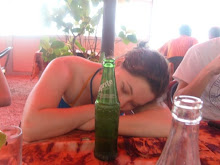
I have not been sleeping well. Either I can't get to sleep for hours or I wake up throughout the night, or both. It could be the fact that my body is not accustomed to getting up and going to bed at decent and regular hours. It could be that I have not yet gotten used to the persistent braying of goats and the music/noise coming from the nearby mosque seemingly all night and all morning long.
It could also be due to the fact that I am in a constant state of slight discomfort. Never before have I been uncomfortable in so many ways at once. I'm not yet really comfortable speaking French, I'm certainly not comfortable speaking Wolof. Already that eliminates the facet of my life in which I am usually most comfortable, ie my ability to use language effectively and affectively. I live in an unfamiliar house with an unfamiliar family with unfamiliar customs. Despite my efforts, I am still not sure who is supposed to eat what meal where, when you use cutlery (which isn't often), if I am supposed to go and seek out every member of the household and announce my comings and goings or if I should just come and go, what the most effective way to use a squat toilet is. I can't figure out how to lie in my bed without it dislodging the bedframe and I can't figure out how to completely unlock my bedroom door. I feel socially awkward literally ALL THE TIME. In the house I feel awkward when everyone is chattering nimbly in Wolof and I ask a question or say something in my clunky French or even clunkier Wolof. Among my peers, both American and Senegalese, I feel equally awkward. I usually feel pretty socially awkward, but around the people who already know and love me, it seems to be part of my charm? But with people who I have known for nary two weeks yet, I am just weird. I overshare, make jokes that no one thinks are funny, tell stories that go nowhere and demonstrate nothing, and generally talk WAY too much. In five days of Wolof classes I have had as many professors of Wolof, each with a radically different accent/personality/pedagogical method. I don't know my way around, know how to use public transportation, feel comfortable negotiating with taxi drivers, know where there are things to do. Basically, my life is in a constant state of ignorant flux.
Yes, this litany of would might lead you to believe that I am unhappy, but such is not the case. I am happy as a clam in fact (oh to be able to use idiomatic expressions!). My choice of location and program for my study abroad adventure was predicated on the knowledge that I would be forced to live outside of my comfort zone. This is supposed to be challenging and I expected nothing less than to be ferociously uncomfortable. I take solace in my iPod and my favorite sweatshirt and remind myself what a rewarding experience this is and embrace the hilarious awkwardness of my existence.
It is funny to me that the culture/language here seems to be greatly focused on making peole feel comfortable and welcome, but the very elements of the culture/language that are so comforting to the indigenous seem to be precisely what put the uninitated ill at ease. My point is best illustrated by a brief lesson in Wolof grammar.
Wolof is a language permeated with flexible, transmutable, and inconsistent relations. There are many ways to say the same thing, but each separate grammatical construction puts emphasis on a different part of the phrase. Take the sentence, "I have two brothers." There is a sentence structure that says simply that, there is a separate structure to imply "I have two brothers;" another to imply "I have two brothers;" and yet another to indicate that "I have two brothers;" and even one to say "I have two brothers." I know, right? There are also different grammatic elements to indicate that somone is RIGHT here, right here, here, there, over there, way over there, and WAY over there. The actual designation of these spatial relationships are at the discretion of the speaker and vary from person to person.
I hope this little grammar lesson gives a little insight into hoz much broader seemingly objective or quantitative designations are here. The conception of proximity, the concept of duration, quantity, etc. are infinitely variable. One thing that has a markedly different, and across the board, broader meaning is "family." Actual households consist of anywhere from 6 or 7 people at the very least, to 14 or 15. Even that might be a conservative estimate. This includes children, brothers, uncles, aunts, friends of the family, ex-brothers in law, American students.
Thursday, January 17, 2008

Thursday, January 10, 2008
Ka muuññ, muuñ
It's hard to understand how far away I am from home, physically and metaphorically. I was thoroughly engaged throughout the flight getting to know my traveling companions, so I barely had time to think about or process the physical space between "here" and "there." Then, we were so tired after disembarking that the drive from the airport into the city seems surreal. It is as if I went to sleep and woke up and the world around me had changed, instead of me actively changing my surroundings.
The only time I felt anything besides adrenaline-fueled camraderie was when the three of us decided it would probably be a good idea if we caught some zzz's on our way to Casa. In my half-slumber, I suddenly felt pangs of acute claustrophobia. This is not uncommon for me on planes, but this time it felt different. It wasn't so much the plane itself that made me feel trapped, but the knowledge that now, halfway to Senegal, there was no turning back. No turning back the plane, no going back to school, no returning to something comfortable. I am a girl who likes to keep her options open and suddenly I understood that going this far abroad means that I have committed myself to something very big for at least the next six months. The geographic agency that I am used to, whether it be subway or NJTransit or even knowing my way around my city, and the communicative liberty I depend on, both in terms of my more than porficient grasp on the English language and the comfort of cellphones and Gchat, are long gone. These aren't exactly profound statements, but there was no way for me to really conceptualize this committment to disconnection and reconnection.
Now that I am here, I find the disconnect at times liberating and at times terrifying. Thankfully, the Senegalese people live by the philosophy of Teranga, which encompasses obligatory and unconditional hospitality in every aspect of life, so people are quite friendly to say the least. Never have I experienced such an extraordinarily generous group of people in my entire life It is as if everyone who sees us wants to welcome us to their country and make sure that we are happy and comfortable. Any time a group of Toubabs (translates literally to strangers, but the general slang for white people) passes, people greet us with "Asalaa malekum," and now that we can answer back, our interlocutors smile proudly and test our Wolof with the follow-up, "Nanga def?" I haven't learned enough to go much further than that, but people seem to know our syllabus and give us the prompts in our workbooks.
I have since my last post moved in with my host family, which is lovely. It is definitely challenging, but as the Wolof say, "ka muññ, muuñ," or "he who endures will smile." So far, the one friend I have made in my family is Mamdia. She is three and speaks about as much French as I do Wolof. I have learned from her kai, which means come, and kii, which means her, and mostly deedeet! which means no. I am very often wrong during her favorite game of take-all-the-toys-out-of-the-bag-and-then-put-them-back-in-again. I hope to make more friends in my family, but it has been a slow process. One thing I have learned is that things take time here. So, babeneen yoon!
The only time I felt anything besides adrenaline-fueled camraderie was when the three of us decided it would probably be a good idea if we caught some zzz's on our way to Casa. In my half-slumber, I suddenly felt pangs of acute claustrophobia. This is not uncommon for me on planes, but this time it felt different. It wasn't so much the plane itself that made me feel trapped, but the knowledge that now, halfway to Senegal, there was no turning back. No turning back the plane, no going back to school, no returning to something comfortable. I am a girl who likes to keep her options open and suddenly I understood that going this far abroad means that I have committed myself to something very big for at least the next six months. The geographic agency that I am used to, whether it be subway or NJTransit or even knowing my way around my city, and the communicative liberty I depend on, both in terms of my more than porficient grasp on the English language and the comfort of cellphones and Gchat, are long gone. These aren't exactly profound statements, but there was no way for me to really conceptualize this committment to disconnection and reconnection.
Now that I am here, I find the disconnect at times liberating and at times terrifying. Thankfully, the Senegalese people live by the philosophy of Teranga, which encompasses obligatory and unconditional hospitality in every aspect of life, so people are quite friendly to say the least. Never have I experienced such an extraordinarily generous group of people in my entire life It is as if everyone who sees us wants to welcome us to their country and make sure that we are happy and comfortable. Any time a group of Toubabs (translates literally to strangers, but the general slang for white people) passes, people greet us with "Asalaa malekum," and now that we can answer back, our interlocutors smile proudly and test our Wolof with the follow-up, "Nanga def?" I haven't learned enough to go much further than that, but people seem to know our syllabus and give us the prompts in our workbooks.
I have since my last post moved in with my host family, which is lovely. It is definitely challenging, but as the Wolof say, "ka muññ, muuñ," or "he who endures will smile." So far, the one friend I have made in my family is Mamdia. She is three and speaks about as much French as I do Wolof. I have learned from her kai, which means come, and kii, which means her, and mostly deedeet! which means no. I am very often wrong during her favorite game of take-all-the-toys-out-of-the-bag-and-then-put-them-back-in-again. I hope to make more friends in my family, but it has been a slow process. One thing I have learned is that things take time here. So, babeneen yoon!
Monday, January 7, 2008
Une suite des gentilhommes
My journey began on Saturday evening when I met two of the three other people on my program for the first time during our seen hour flight to Casablanca. Thankfully, we really hit it off and have many similar interests. Also thankfully, my compatriot Julia had a massive guideook for all of Africa, so we planned ourselves an excursion during our eleven hour layover in Casablanca.
Our experience trying to find the train to get from the airport to the city pretty much summed up our experience in Casa (as it is known to the locals): we spent a good long while wandering around looking hopelessly out of place unsure of what the train line was or where exactly we were supposed to take it, until we serendipitously stumbled upon a great big sign flashing "WELCOME TO THE TRAIN" in French, English, and Arabic.
The train dropped us off near the city center, and we were approached by a swarm of petit taxi rouges upon exiting the station. Not wanting to be duped, and unsure of our abilities to barter, we decided that we could walk to our first destination, the big mosque. Its name escapes me, but it is the third largest mosque in the world (but not the oldest; it was built starting in 1987, we are the same age!). We left the train station and tried to find ourselves on the world's tiniest map, which probably made us look like the most obvious tourists of all time. We looked undeniably lost when a taxi driver walked up to us. He evaded the task of showing us where we were on the map by promising to take us directly to the mosque for 50 dirham, which is about 4 dollars. That seemed like a fair price, so we agreed to let him take us. En route, he tried to sell us on a 300 dirham two-hour tour of the city, which we hesitantly declined. After finding out later that we were way closer to the mosque than he had led us to believe, and that the fare could have been something like 10 dirham, we were glad we had passed.
The mosque was gorgeous and had the world's largest sunroof. Seriously, they have a button to oen up the roof when it gets hot. We took a tour with a hilariously sassy tour guide who seemed very indignant to have to be waiting for a Romanian translator to repeat her spiel to his group (although the Romanian tourists were inexplicably even more indignant). Sometimes she would whisper us facts so that the translator couldn't hear; I guess she like us better. She gave us drections to the old Medina where she assured us that we would find a good restaurant for lunch.
We followed her directions and found ourselves in the middle of a claustrophobic maze of alleys with nary another foreigner in sight. We Were again very obviously lost when a friendly man approached us and introduced himself. Our new friend, Reda offered to help us find a suitable place to eat. After following him through the windy back alleys for about fifteen minutes, we decided that this might not have been the best idea and asked him to bring us somewhere to get a taxi. He kindly complied and said that the next time we are in Casa we should be sure to visit his family's store. Now we know where he was going with us.
We again tried to get our bearings with the map and spent another half an hour trying to find the restaurant suggested by Julia's guidebook as a cheap and good place to eat. Despite its purported fame, no one seemed to have ever heard of it and/or gave us completely unhelpful directions. Finally, we were approached by Walid, who gave us directions but told us that the restaurant was a complete tourist trap. He offered to show us a more authentic place in exchange for the opportunity to practice his English. We enjoyed authentic couscous and delicious Moroccan tea and talked about religion, politics, and language. Walid said he would show us the king's palace and then send us off to the train station to return to the airport. Things were going well for a while, and he was an excellent guide, but when he pressed us to lend him money and we did not comply, he pointed us to the train and took off in the other direction. We decided to take a taxi back, to ensure that we made it safely, and even managed to catch a glimpse of the palace along the way.
Waiting for the train, we talked to an older French couple who were retourning from Toulouse after a week-long trek through the Sahara. They commended us on our French and wished us luck with our studies. On the train we chatted up our seatmate Haleel, who told us of his travels all around Europe. He gave us advice on things to do in Dakar and congratulated us on our adventurousness. While waiting for our plane, we befriended François Gerard and his older sister and younger brother. They were returning to their home in Dakar after a week of skiing in Maine. It was also the eve of François' fifth birthday and he promised that if I came to his party he would give me lots of presents and even make me a surprise cake. Unfortunately, I had to decline his generous offer.
We came to Dakar many friends richer but more exhausted than ever. We were met at the airport and driven to our apartments where we crashed for the night. The accomodations are very nice, and we have hot showers and comfortable beds. In the morning we were greeted by a delicious breakfast of bread with jam, cheese, and chocolate and coffee. We were joined by Samba, who was to take us to the Baobab Center, the organization hosting us in Dakar. Samba, in addition to doing cross cultural orientations for the Baobab Center, is an accomplished documentary film maker and promised to put us in contact with the most interesting people to help us with our research projects.
If you made it all the way to the end, congratulations! I have so much more to say, but I've already burdened you with this novella, so I'll save the rest for later.
A bientot!
Our experience trying to find the train to get from the airport to the city pretty much summed up our experience in Casa (as it is known to the locals): we spent a good long while wandering around looking hopelessly out of place unsure of what the train line was or where exactly we were supposed to take it, until we serendipitously stumbled upon a great big sign flashing "WELCOME TO THE TRAIN" in French, English, and Arabic.
The train dropped us off near the city center, and we were approached by a swarm of petit taxi rouges upon exiting the station. Not wanting to be duped, and unsure of our abilities to barter, we decided that we could walk to our first destination, the big mosque. Its name escapes me, but it is the third largest mosque in the world (but not the oldest; it was built starting in 1987, we are the same age!). We left the train station and tried to find ourselves on the world's tiniest map, which probably made us look like the most obvious tourists of all time. We looked undeniably lost when a taxi driver walked up to us. He evaded the task of showing us where we were on the map by promising to take us directly to the mosque for 50 dirham, which is about 4 dollars. That seemed like a fair price, so we agreed to let him take us. En route, he tried to sell us on a 300 dirham two-hour tour of the city, which we hesitantly declined. After finding out later that we were way closer to the mosque than he had led us to believe, and that the fare could have been something like 10 dirham, we were glad we had passed.
The mosque was gorgeous and had the world's largest sunroof. Seriously, they have a button to oen up the roof when it gets hot. We took a tour with a hilariously sassy tour guide who seemed very indignant to have to be waiting for a Romanian translator to repeat her spiel to his group (although the Romanian tourists were inexplicably even more indignant). Sometimes she would whisper us facts so that the translator couldn't hear; I guess she like us better. She gave us drections to the old Medina where she assured us that we would find a good restaurant for lunch.
We followed her directions and found ourselves in the middle of a claustrophobic maze of alleys with nary another foreigner in sight. We Were again very obviously lost when a friendly man approached us and introduced himself. Our new friend, Reda offered to help us find a suitable place to eat. After following him through the windy back alleys for about fifteen minutes, we decided that this might not have been the best idea and asked him to bring us somewhere to get a taxi. He kindly complied and said that the next time we are in Casa we should be sure to visit his family's store. Now we know where he was going with us.
We again tried to get our bearings with the map and spent another half an hour trying to find the restaurant suggested by Julia's guidebook as a cheap and good place to eat. Despite its purported fame, no one seemed to have ever heard of it and/or gave us completely unhelpful directions. Finally, we were approached by Walid, who gave us directions but told us that the restaurant was a complete tourist trap. He offered to show us a more authentic place in exchange for the opportunity to practice his English. We enjoyed authentic couscous and delicious Moroccan tea and talked about religion, politics, and language. Walid said he would show us the king's palace and then send us off to the train station to return to the airport. Things were going well for a while, and he was an excellent guide, but when he pressed us to lend him money and we did not comply, he pointed us to the train and took off in the other direction. We decided to take a taxi back, to ensure that we made it safely, and even managed to catch a glimpse of the palace along the way.
Waiting for the train, we talked to an older French couple who were retourning from Toulouse after a week-long trek through the Sahara. They commended us on our French and wished us luck with our studies. On the train we chatted up our seatmate Haleel, who told us of his travels all around Europe. He gave us advice on things to do in Dakar and congratulated us on our adventurousness. While waiting for our plane, we befriended François Gerard and his older sister and younger brother. They were returning to their home in Dakar after a week of skiing in Maine. It was also the eve of François' fifth birthday and he promised that if I came to his party he would give me lots of presents and even make me a surprise cake. Unfortunately, I had to decline his generous offer.
We came to Dakar many friends richer but more exhausted than ever. We were met at the airport and driven to our apartments where we crashed for the night. The accomodations are very nice, and we have hot showers and comfortable beds. In the morning we were greeted by a delicious breakfast of bread with jam, cheese, and chocolate and coffee. We were joined by Samba, who was to take us to the Baobab Center, the organization hosting us in Dakar. Samba, in addition to doing cross cultural orientations for the Baobab Center, is an accomplished documentary film maker and promised to put us in contact with the most interesting people to help us with our research projects.
If you made it all the way to the end, congratulations! I have so much more to say, but I've already burdened you with this novella, so I'll save the rest for later.
A bientot!
Subscribe to:
Posts (Atom)